
Garage spray foam insulation removal is one of the most misunderstood jobs in UK property maintenance right now. Homeowners install it thinking it’s a cheap, easy win. Then they try to sell. Or remortgage. And that’s when the problems start. This guide gives you the straight facts: what spray foam does to your garage structure, why lenders hate it, what proper removal looks like, and how to protect your property value before it’s too late.
Why Garage Spray Foam Insulation Is Causing Real Problems
There has never been any aggressive advertising of the spray foam amongst British homeowners in the last twenty years. Government programs, advertisements on TV, door-to-door marketers all played a role in convincing people that the use of spray foam would allow them to retain warmth inside their homes and, therefore, save money from heating expenses. Nobody had told any lies in this case; nevertheless, there is another side to the coin.
Spray foam is a material that sticks to whatever it gets attached to. In case of its application in the attic and roofs, it sticks to the beams made of wood. Similarly, when applied to the garage, the foam sticks to the walls and ceilings as well as the blocks of concrete. Once cured, the likelihood of peeling off is very small. The water will get trapped inside the construction and prevent the beams from breathing and drying up.
The Two Types You’ll Find in UK Garages
Open cell spray foam is the softer, spongy type. It expands dramatically during application and has a honeycomb-like interior. It absorbs water. That’s a problem in UK climates where dampness is already a constant battle. Removing open cell spray foam from the garage is relatively easy compared to its counterpart but requires expertise nonetheless.
Closed cell foam is more compact and rigid.
Closed cell foam is denser and harder. It forms a rigid shell. It’s stronger but more damaging to structural timber because it adheres with far more force. Closed cell foam removal from a garage takes more time, more specialist equipment, and more care. It adheres strongly to both masonry and wood surfaces. Differentiating the kind of foam will affect the removal process and price tag. Any contractor who quotes without inspecting first isn’t someone you should trust.
The Mortgage Problem Nobody Warned You About
Here’s the issue that’s sending homeowners into a panic. Major UK mortgage lenders, including Halifax, Nationwide, and Santander, will either refuse a mortgage or request a detailed survey if spray foam insulation is present in a property. Some lenders won’t lend at all, regardless of the foam’s condition. The Royal Institution of Chartered Surveyors (RICS) flagged this formally. Surveyors are now required to note spray foam presence in their reports. That note alone can kill a sale or a remortgage application.
It’s not just residential lofts. If your garage is attached to your house, or if it forms part of the main building fabric, surveyors will inspect it. Foam in the garage ceiling? That’s noted. Foam sprayed against the party wall? Also noted.nYou don’t have to be selling to feel the pressure. Releasing equity, switching lenders, or getting a buy-to-let mortgage on a property with spray foam is increasingly difficult. Landlords are finding this out the hard way.
What Professional Garage Spray Foam Insulation Removal Actually Involves
The foam spray removal procedure cannot be carried out by someone alone at the weekend. The following are the steps that should be taken when the process is being conducted in the proper way.
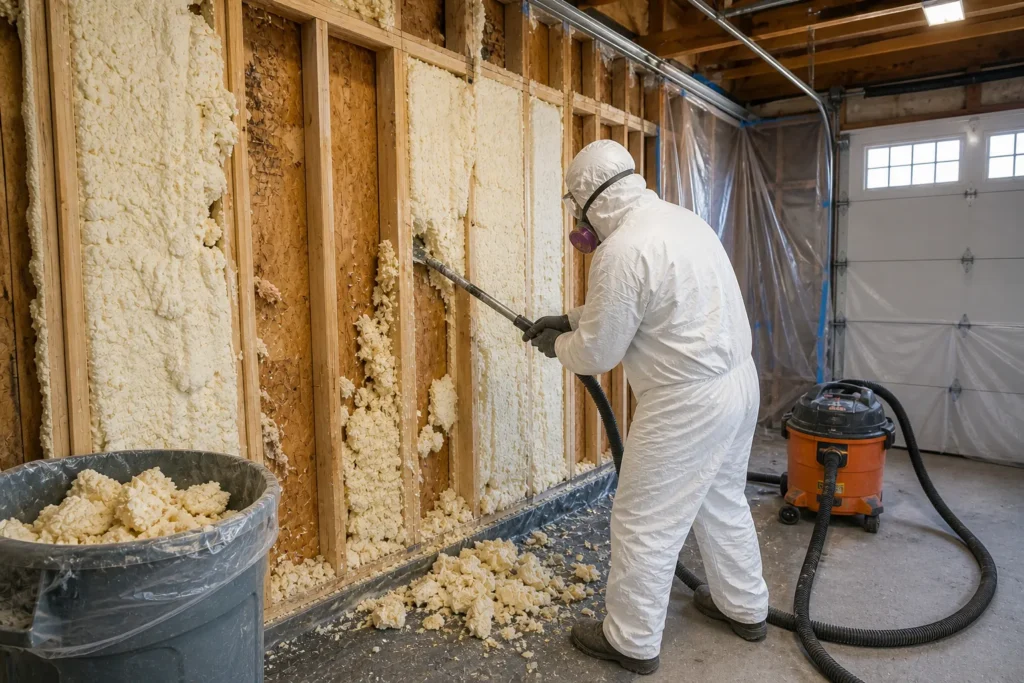
Assessment and Inspection First
An inspection will be conducted in your garage by a professional before commencing the work. The first step involved will include establishing the type of the foam, how thick the foam is, the areas that are covered by the foam and if there are any signs of damage to the wood. Most of the garages with spray foam installed on them had previous issues before installation of foam.
Mechanical Removal of the Foam
Depending on the foam type, removal is done with hand tools, specialist scrapers, or mechanical grinders. Open cell foam often comes away in large sections. The closed cell is cut and chiselled off in smaller pieces. Both produce significant debris. The workspace is sealed and protected. Foam particles are airborne during removal. Operatives wear respiratory protection. This isn’t something you can do with a Stanley knife and a hoover.
For garage ceilings and walls, access equipment is often needed. The work is slower and more physical than most homeowners expect.
Surface Preparation After Removal
Getting the foam off is one thing. Leaving a surface in a state where new insulation can be properly fitted is another. The residue that’s left behind after mechanical removal has to be cleaned back properly. Any adhesive residue, foam fragments, or contamination compromises the bond of whatever goes on next.
This is where many cheaper operators cut corners. They pull the bulk of the foam off and call it done. A proper job includes surface preparation to a standard that allows replacement insulation to perform correctly.
Structural Assessment Post-Removal
With the stripping of the entire foam layer completed, it is imperative that one examines the wood/brick beneath the foam layer. Should there be any sign that moisture was retained, it would be obvious that even before removing the foam, the softwood had begun rotting. Yet, hope still remains.
If timber replacement is needed, that’s a separate scope of work. A good removal contractor will either handle it directly or document it clearly so you can get it remediated before new insulation goes in.
Spray Foam Insulation Removal Cost: What to Expect
It is feasible to estimate the cost of removing spray foam insulation by examining three essential elements: area size, foam type, and substrate material conditions used. In general, the cost of removing spray foam insulation from a standard garage of a regular-sized home would generally be estimated within the amount of £500 to £2,500. Larger double garages or garages with foam applied across multiple surfaces sit at the higher end. If structural timber work is needed on top, costs increase further.
Don’t use price as your primary filter. The cheapest quote usually means the fastest job with the least care. And a rushed foam removal that leaves residue, causes timber damage, or doesn’t prepare the surface properly will cost you far more when the surveyor comes back. It is recommended that you request at least three quotations. The firm should explain what is included within the quotation and what is not. They need to specify how they plan on handling any damage caused. If the firm cannot give you such details, it shows they are not ready to undertake the job.
Looking for professional quotations? Elite Spray Foam Insulation Removal provides complimentary and no-obligation site inspections for spray foam garage insulation removal in the UK. Click here.
Choosing the Right Garage Insulation Removal Experts
The spray foam removal industry in the UK has grown fast. And not all of it has grown well. There are experienced, specialist firms doing excellent work. There are also generalist builders who’ve added foam removal to their service list without the training to back it up.
Apart from the already discussed aspects, there are many other factors that must be considered prior to choosing the right contractors for the job of insulation stripping.
Experience: The next factor to consider here is the issue of experience. Has the particular contractor any prior experience in carrying out such jobs before? In what way can one compare the contractor with six months of experience in his trade compared to another with ten years of experience?.
Test them for their knowledge about the mortgage issue: A knowledgeable contractor will know the reasons behind the concern of the banks and the operations of the surveyors. Lack of information with regard to the technical and financial problems that come with the process of foam removal implies that their expertise in the field is low.
Confirmation of work after completion: With regard to mortgage, you may want confirmation of full foam removal. It may be the case that your contractor cannot provide you with that assurance.
Eco-friendly foam removal: As people today become more concerned about environmental issues, contractors have also been found to engage in environmentally friendly methods of foam removal. For any concerns that you might have regarding the environmental impacts of foam removal, you can find out the views of your contractor in that regard.
What Replaces the Foam After Removal
The task at hand is to remove the spray foam. However, you will need to insulate your garage if this was its initial function. The alternatives for garage insulation replacement vary according to your garage construction and usage, such as rigid boards, mineral wool, or breathable membranes. For a garage that’s used as a workshop or habitable space, the replacement specification matters more. For a purely functional storage garage, the requirements are simpler.
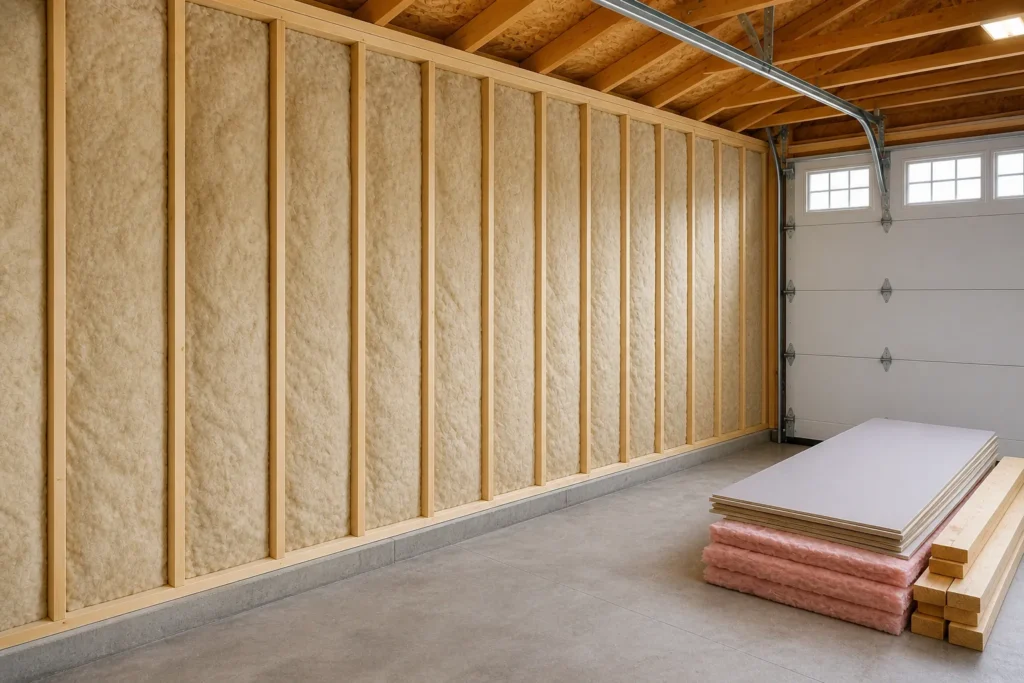
A good removal contractor will either advise you on replacement options or connect you with an insulation specialist who can. Don’t leave your garage uninsulated after removal and assume you’ll sort it later. An uninsulated garage after foam removal often performs worse thermally than before the foam was ever installed.
Attic and Garage Foam Removal: Is Yours Linked?
In many UK properties, particularly 1970s and 1980s builds, the garage is structurally linked to the main dwelling. The roof structure continues across both. Loft insulation and garage ceiling insulation may have been applied in the same campaign.
If your property has spray foam in the loft as well as the garage, both areas need assessing together. Surveyors will inspect both. Treating them as separate problems leads to separate removal contracts, higher cost, and the risk of getting one area signed off while the other remains flagged. If you’ve already had foam removed from your loft but not your garage, or vice versa, get the second area surveyed as a priority. A single surveyor flag on a property is one thing. Two separate flags is a much harder conversation with a lender.
Elite Spray Foam Insulation Removal handles both attic and garage foam removal as part of an integrated service. Find out more on the loft and attic spray foam removal page.
FAQ’s:
Is the removal of spray foam insulation possible in the garage without any help from others?
Definitely yes, it can be done personally. However, such work is undesirable for a huge number of homeowners due to the complexity of working conditions. Moreover, the closed-cell insulation needs not only physical strength but also specialized equipment for its removal. Nevertheless, the main problem of doing everything on my own is that I won’t be able to receive proof necessary for the creditors and surveyors. An expert would give proof of doing the removal of spray foam insulation personally.
Will the spray foam influence my mortgage application?
Undoubtedly, the use of spray foam has an impact on getting a mortgage. But at the same time, the proper removal of spray foam with all the papers will provide no problems regarding getting a mortgage. The point is that when an expert writes a report stating there are no defects in the walls, even if a creditor asks for a house structural survey, there won’t be any problems regarding the mortgage application.
How long does garage spray foam removal take?
A standard single garage takes one to two days. Larger garages, or those with particularly thick foam applications, may take longer. If structural repairs are needed after removal, that’s a separate programme of work. Your contractor should give you a realistic timeline at the inspection stage.
Will my insurance coverage be canceled if there is spray foam in my garage?
Absolutely, there are certain insurance companies that may have doubts regarding the effect of the spray foam on the ability of insurance inspectors to inspect the timbers. It would be advisable for you to contact your insurance company or read your insurance coverage details. That is another reason why it is advisable for spray foam to be removed.
Will I receive any warranty service from the companies for the removal of the spray foam?
Yes, the service will definitely come with a warranty. However, the problem is that contractors can never give warranties regarding the substrate since there is a risk of damage to the foam when removing it.
What makes me know whether the garage foam is either an open or closed cell?
An open cell foam is softer compared to the closed cell foam which is dense. A professional will identify which type you have during the initial inspection. In some garages, both types have been used in different areas. Don’t assume it’s one or the other without having it confirmed.
My garage foam was installed under a government scheme. Does that change anything?
No. The source of the original installation doesn’t change the removal requirement. Some installers under those schemes used products or application methods that are now considered problematic. If you were given a guarantee by the original installer, it’s worth checking whether the firm still exists, but don’t rely on it. The structural and lending concerns apply regardless of how or when the foam was installed.